Sunday, June 12, 2022

MALI


READ


The Fortunes of Wangrin, written by Amadou Hampaté Bâ and translated by Aina Pavolini Taylor, tells the story of a hustler and a swindler. As a child in French-controlled Mali in the late nineteenth century, Wangrin attends the so-called school for hostages, a French learning establishment where the goal was to wean African children away from their culture so they would identify instead with the French colonizers. Wangrin uses his education to become an interpreter to the local French Commandant.

Wangrin is never content with his current circumstances, whatever they may be. He begins his career as a teacher, but when he discovers that being the Commandant’s interpreter is a better job, he schemes to take the job from the current interpreter. He then builds a network of informers, and finds ways to enrich himself and those closest to him. And so goes his career. He takes every opportunity to move up the ladder, without regard for anyone who may be harmed by his upward mobility. This tendency earns him some powerful enemies.

His conniving ways often result in legal difficulties for him, but he somehow manages to come through relatively unscathed. He’s also very superstitious, relying heavily on patron-gods, marabouts, geomancers, and other mystics and holy men to look into his future and advise him on how to proceed. Sometimes this works in his favor, and sometimes it doesn’t, especially if he doesn’t do exactly as he’s told.

The Fortunes of Wangrin is also a book about colonialism, and the uneasy relationship between the colonizers and the colonized. When Wangrin first begins working as a teacher, the French Commandant tells him that “… it is our mission to bring happiness to the Black peoples, if need be against their own wishes.” Apparently they mean to do that by substituting the French way of doing things for the Malian way of doing things. Being the trickster that he is, Wangrin is usually able to find a way around the French administrators, although he is not always trusted.

The author, who also attended the school for hostages, based the character of Wangrin on a man he met when he was a child. He used many of the stories told to him by that man to form the basis for this book. As a historian and a folklorist, Bâ was uniquely qualified to turn these oral stories into written literature.

The Fortunes of Wangrin occupies an important role in African literature, both for its portrayal of French colonization and its respect for oral literature. As Bâ himself was fond of saying, “Whenever an old man dies, it is as though a library were burning down.” With The Fortunes of Wangrin, he managed to preserve one such library after an old man’s death.


COOK


The Fortunes of Wangrin didn’t provide me with any inspiration for a Malian culinary creation, so I did an Internet search to see what I could find. There were a few options, but I decided to try the one that sounded most unusual and unlike anything else I’ve cooked for this blog: plantain and coconut stew. The recipe was on the Together Women Rise website, and it was attributed to The Soul of a New Cuisine: A Discovery of the Foods and Flavors of Africa, by Marcus Samuelson. The ingredient list didn’t mention chilies, but the instructions did, so I included one chopped jalapeño pepper.

Gotta say, this wasn’t one of my better culinary efforts. I’m not used to cooking with plantains, for starters, and the vinegar in the stew made it a little too sour. Maybe it will taste better tomorrow, after the flavors have melded, but I’m not holding out much hope.


GIVE


Mali is approximately two-thirds desert, and climate change has resulted in both extreme floods and devastating droughts. This makes it difficult for families to grow food, since they are never sure what the weather will bring, and some crops that grew well previously may not produce as much food now.

Climate change is especially hard on Malian women. According to Foune Coulibaly Wadidie, Minister for Advancement of Women, Children and Family of Mali, women “make up half of the country’s population of 20 million and contribute between 60 to 80 per cent of its food resources. However, climate change severely affects agricultural and related sectors, and economic constraints stemming from cultural norms mean that women’s livelihoods are dependent on the climate.”

I searched the projects at GlobalGiving to see if I could find one that might address this issue. I found a project organized by AGILE-International that would drill two wells for 186 women farmers in Mali. According to the description, this project provides “income-generation opportunities through agriculture, allows rural women to gain access to education, achieve economic autonomy, feed and shelter their families. AGILE will train women to drill wells, maintain them, and manage water resources.” More information about this project is available at: Drill 2 wells for 186 women farmers in Mali - GlobalGiving.


NEXT STOP: MALTA


Sunday, May 1, 2022

MALDIVES


READ


In December of 2004, an earthquake off the coast of Indonesia caused a massive tsunami that devastated the coastal regions of several countries and killed more than 200,000 people. Fifty-seven islands in the Republic of Maldives experienced severe flooding, and 108 people on the islands were killed.

This tragedy appears to have been the basis for the plot of Ocean Hues, by Maldivian author Amyna. The author offered to send me a copy of this book when I wrote to her a few years ago to ask if she had been born in the Maldives. I had been planning to read her book, Foiled, but was delighted when she sent me Ocean Hues, so I decided to read it instead. 

The book opens with an introduction to a young couple, Hawwa and Hussein, who are living happily on an island in the Maldives with their five-year-old son Shuaib. Hawwa has not seen her parents, who live on an island a twenty-minute boat ride away, for more than a year because Hussein has been too busy with work to go with her. She persuades him to let her and Shuaib go for a week-long visit without him. They are very much in love and have never spent a night apart during their marriage, so the idea of being separated for a week is hard on both of them. Nevertheless, Hawwa and Shuaib embark on their short journey to visit Hawwa’s parents.

The first couple of days go well, with friends and family coming by to visit. But one morning, when Shuaib and his cousins are playing on the beach, a huge wall of water comes toward them. They can hear Hawwa’s voice pleading with the boys to come to her, but they are powerless to move.

The tsunami has also reached their home island. Hussein clings to a pillar to avoid being swept away, and watches as the water carries several items out the door. After the water subsides, he tries to call Hawwa, but there is no phone service. He finds an acquaintance who is willing to take him to the island where Hawwa and Shuaib are staying. When he reaches his in-laws’ house, he’s overjoyed to see that Shuaib is safe. His joy quickly turns to sorrow, however, when he learns that Hawwa is missing.

Meanwhile, a beautiful young woman has been found unconscious, floating in the Indian Ocean off the coast of Sri Lanka, by a group of men on a pleasure-fishing excursion. They rescue her and take her to a hospital, where it becomes apparent that she has amnesia.

The plot drew me in and kept me interested from beginning to end. Almost all of the characters were likeable and honorable, trying to do the right thing for everyone involved. The suspense came from the circumstances that kept the characters in the dark as they looked for answers following the chaos that nature wrought.


COOK


When Hawwa and Shuaib go to visit Hawwa’s parents, they have a lunch of the curries that Hawwa’s mother had cooked in anticipation of their arrival. I looked online for a Maldivian curry recipe and found one for tharukaaree riha, a vegetable curry, on the International Cuisine website. It’s different from other curries I’ve made because it doesn’t contain curry powder or any type of curry spice blend. Instead, the recipe calls for six curry leaves, which I found at a local Indian market. It also calls for pandan leaf, which I wasn’t able to find at all. I searched the Internet to see what I could substitute for the pandan leaf, and found several suggestions, most of which bore no similarities to the others. Since one of the suggestions was cilantro, which I had on hand, I just used that. The dish featured sweet potato, pumpkin (I used butternut squash instead), green beans, carrots, and coconut milk, and I really enjoyed the rich taste. I would definitely make this again.


GIVE


GlobalGiving, which is my go-to organization for international non-profit projects, didn’t have anything listed for the Maldives. So I did a little Google search and found the Maldives Whale Shark Research Programme, which “is a research-based conservation charity dedicated to studying the whale shark and fostering community-focused conservation initiatives in the Maldives and the greater Indian Ocean.”

According to their website: “…we seek to advance the field of whale shark knowledge and to advocate for sound conservation policy in the Maldives. By encouraging and valuing community and industry stakeholder participation, we are able to leverage the scientific research to safeguard the rich biodiversity and fragile marine ecosystems that are the basis for not only whale sharks, but also life, livelihood and culture in the Maldives.”

More information about this organization is available at Maldives Whale Shark Research Programme | Conservation through Research and Community Mobilisation.


NEXT STOP: MALI


Saturday, April 16, 2022

MALAYSIA


READ


The Rice Mother, by Rani Manicka, is a sweeping family saga, beginning in the early twentieth century and continuing into the twenty-first century. It’s the story of Lakshmi, who was born in Ceylon in 1916, beloved daughter of a woman who had married badly and who tries to do better by Lakshmi. She arranges fourteen-year-old Lakshmi’s marriage to a thirty-seven-year-old Malayan widower with two children, whom she believes to be a man of wealth and position. After the wedding, the groom, Ayah, takes Lakshmi back to Malaysia with him and she never sees her mother again.

When Lakshmi arrives at Ayah’s home, she learns how badly her mother had been deceived about Ayah’s circumstances. Nevertheless, she takes on the challenge of setting up housekeeping and improving their situation. Over the next several years, she is often pregnant, giving birth to six children by the time she is nineteen. While the family is not rich, they manage well enough, and the children have a fairly happy childhood.

However, everything changes on December 13, 1941, when the Japanese invade Malaysia. Murder, rape, and theft by the Japanese occupiers is rampant, and Malaysian families go to great lengths to hide their daughters. Some, like Lakshmi’s daughter Anna, have their hair cut short and are dressed in boys' clothing to hide the fact that they are girls. Others, such as Lakshmi’s uncommonly beautiful daughter Mohini, are hidden completely from the outside world.

The Japanese occupation lasts for more than three years, but the psychological and physical damage caused by the occupation stays with Lakshmi and her family forever. Their stories are collected on tape much later by Lakshmi’s granddaughter Dimple, and the book’s chapters are narrated by various family members at Dimple’s prompting.

Lakshmi is a strong woman, whom her son Sevenese refers to at one point as the “Rice Mother.” He tells Dimple that she is “the keeper of dreams. Look carefully, and you will see, she sits on her wooden throne, holding all our hopes and dreams in her strong hands, big and small, yours and mine. The years will not diminish her.” Yet even a matriarch as fierce as Lakshmi is unable to prevent the fates that await her children and grandchildren. 

The Rice Mother held my attention from beginning to end, despite the tragedies faced by all the characters. What a wild ride it was!


COOK


Many of the specific dishes mentioned in The Rice Mother were from Ceylon, where Lakshmi had spent her childhood. A couple of Malaysian desserts that made their way into the book – coconut cookies and Nyonya cake – sounded delicious, but required ingredients I couldn’t get and appeared to be more complex than my cooking skills would allow. So I searched the Internet and found a recipe at VeggieDesserts.com for laksa, a spicy soup made with vegetable broth and coconut milk, to which rice noodles, snow peas, mung bean sprouts, and baby corn are added. It sounded like it should taste better than it actually did – it was a bit on the bland side. I used low-sodium vegetable broth, but I think a little salt would have improved the flavor immensely.


GIVE


One effect of climate change throughout the world has been the decline in healthy coral reefs. These reefs are needed to provide food to countless numbers of marine species, and their loss could threaten the entire ocean food chain. On the GlobalGiving website, I found a project that would help protect the coral reefs on the Malaysian islands of Tioman, Mantanani, and the Mersing group.

According to the project description: “Coral reefs provide food source and employment for millions around the world, especially coastal communities. They act as an important carbon sink, which helps in our fight against climate change. Despite being ecologically and economically important, coral reefs are under increasing threats from human pressures such as overfishing, marine litter, sewage pollution, unsustainable tourist numbers, and coastal development. They also face natural threats from climage change and global warming.”

This project will provide funding that Reef Check Malaysia will use to “track and monitor the health of coral reefs at over 220 sites around Malaysia. Equipped with reliable data, we will develop reef management and conservation plans according to site specific needs. Recently damaged coral reef sites can be rehabilitated. Coral reefs that are affected by pollution can be addressed by promoting environment-friendly tourism practices. We will also advocate for policy changes to reduce human impacts in marine park areas.”

More information about this project is available at Protect Coral Reefs in Malaysia - GlobalGiving.


NEXT STOP: MALDIVES


Wednesday, March 23, 2022

MALAWI


READ


No Easy Task, by Malawian author Aubrey Kachingwe, follows the life of Jo Jozeni, a young man living in an unnamed British colony in Central Africa. Jo would like to study law, but cannot obtain a scholarship to study abroad. Instead, he goes to work as a cub reporter for the Kawacha News in the city of Kawacha, not far from the village where he grew up.

Living and working in the city awakens him to the politics of being African in a country that is ruled by the British. Although there are a few Africans on both the Legislative Council and the Executive Council, they are appointed to those positions by the British, rather than nominated and elected by the people of the country.

The Kawacha News is owned by white British men as well, although shortly after Jo goes to work for the paper, the white editor and his partner quit and sell the paper to new owners. They give the editor position to an African man, but the new owner is still white and British.

It seems clear throughout the book that the country is trying to move toward independence. On the British side, however, there is the belief that the “country has reached its present progress and prosperity mainly because we, the non-Africans, have provided the capital, the initiative and the know-how.” Therefore, they are reluctant to give up their leadership role.

Naturally, the Africans whose country has been colonized have a different view. Jo’s father, who describes the British as guests, has this to say: “We are full of human love. In our hearts, we are full of generosity. We give a place to sleep and food to eat to our guests in our houses. We treat them like members of our own families. Good guests ask no more than we can give. But a guest who wants the best that can be had in our house at the expense of us – such a guest we will ask to leave our house. We cannot have him. We don’t want him.”

While most of the plot of No Easy Task involves politics, Jo’s day-to-day life is chronicled as well. Moving away from the village to the city is a big step for him, and he has to learn whom to trust. At first, he lives with his sister Mary and brother-in-law Felix, but after Felix gets into trouble for being involved in an unlawful protest, he loses both his job and his employer-owned housing. It seems that some kind of trouble or another is always in Jo’s path.

I found No Easy Task to be interesting and thought-provoking, showcasing colonialism as it winds down, rather than when it’s at full strength.


COOK


Although eating certainly occurred in No Easy Task, specific dishes weren’t mentioned. I searched the Internet and found several recipes for Mbatata, which are sweet potato cookies. I tried the one from the Curious Cuisiniere website, using Earth Balance instead of butter to make the cookies vegan. All the recipes seemed to indicate that these cookies should be made heart-shaped to honor the people of Malawi, who are known for their hospitality and friendliness. I don’t know if traditional Malawian sweet potato cookies are really cut in heart shapes or not, but I did as the recipe suggested. The cookies were good – not too sweet – and I was sorry the recipe made such a small batch.


GIVE


As is the case with other African countries, climate change has hit Malawi hard. This was on my mind as I searched through the GlobalGiving website for a project to support. The one that caught my eye was a project to construct a solar irrigation system for thirty farming families. According to the project description, food insecurity is a major issue in Malawi, and the “district of Balaka is especially vulnerable and increasingly hit by natural disasters as a result of climate change.” 

Building a solar-powered irrigation system “gives a reliable water supply to farmers making two harvests per year possible and increasing their long-term food security and income.” As part of this project, farmers will also be trained in desirable crop selection and equipment maintenance.

More information about this project is available at Empower 30 Malawian Families with Solar Irrigation - GlobalGiving.


NEXT STOP: MALAYSIA


Monday, March 7, 2022

MADAGASCAR


READ


When I first started this project, no novels had been translated into English by authors from Madagascar. Fortunately, by the time I reached Madagascar on my list, translator Allison M. Charette had remedied that situation. The book I read for this post is her translation of Beyond the Rice Fields, by Naivo.

The story takes place in the early to mid-1800s, during the last years of the reign of King Radama I and the first twenty-one years of the reign of Queen Ranavalona I. Tsito is nine years old when his village is destroyed by soldiers and he is sold into slavery. He is purchased by Rado, a trader who gives Tsito to his seven-year-old daughter Fara out of guilt because he has essentially abandoned her and her mother Bao, visiting them only occasionally. Tsito’s life with Fara, Bao, and Bao’s mother Bebe isn’t bad. He works alongside the women in the family, and he plays with Fara and attends school with her. He develops deep feelings for Fara, but knows a relationship is out of the question, since he is a slave.

From time to time, Rado takes Tsito on the road with him. On one of these trips, Tsito meets Ibandro, a strong and powerful slave belonging to the lord of the province. Ibandro takes Tsito under his wing, arranging for him to learn trades and crafts that he hopes will eventually win him his freedom. Eventually, Tsito leaves Fara’s family and goes to work for Ibandro’s master, Andriantsitoha.

This is not just a personal story about Tsito and Fara, however. The history of Madagascar during that era is chronicled in all its tragic detail. Seers, sorcery, and superstition are commonplace, and the people of the kingdom (referred to in the book as the People Under the Sky), are never safe from accusations that could lead to their deaths. When someone is accused of sorcery or any number of other things, they must face an ordeal called tangena, which involves poison. If the person survives, they are generally considered to be innocent of whatever charges had been brought against them. Tens of thousands of people lose their lives in this manner under the reign of Queen Ranavalona I.

Missionaries are active in Madagascar in the early part of this book, and Fara and Tsito learn to read and write at a missionary school. However, after Queen Ravanalona I takes the throne, she basically outlaws Christianity, and anyone who had converted to that religion faces a perilous existence.

Beyond the Rice Fields is told from both Tsito’s and Fara’s perspectives, tracing the arc as his fortunes rise and hers begin to fall. They are both sympathetic characters trying to do their best in life at a time when allegiances shift frequently, and when those in the Queen’s good graces one day may be at risk the next. This book is an unforgettable saga of a horrifying time in Madagascar’s history.


COOK


As is apparent from the title, rice is the main staple of the characters' diet in Beyond the Rice Fields. Other than that, however, the book didn’t supply much in the way of culinary inspiration. So I searched the Internet and found a recipe on the Yummly.com website for a dish called Madagascar Tofu. Essentially, this dish consists of cubed tofu coated with spices and cooked in a light sauce of onion, tomato, and coconut milk. It wasn’t bad, but considering how many spices were involved, I was surprised at how bland it was. Adding a little Tapatío sauce helped immensely!


GIVE


Climate change has been much on my mind lately, to the extent that I’ve even joined an online climate solutions book club. Knowing that Madagascar is suffering from dire climate-caused problems, I decided that my donation would go to climate change-related projects in that country. The GlobalGiving website listed several, and I chose three to support: a reforestation project, a relief fund for a climate-caused famine, and protection for threatened lemur habitat. Information about these projects can be found at the following links:

Planting 15000 trees in Madagascar - GlobalGiving 

Madagascar Famine Relief Fund - GlobalGiving

Protecting Threatened Lemur Habitat in Madagascar - GlobalGiving


NEXT STOP: MALAWI


Monday, February 28, 2022

MACEDONIA

Note: In February of 2019, Macedonia changed its name to North Macedonia.


READ


When I realized that the book I had purchased for Macedonia was a 490-page novel about conjoined twins, I wasn’t thrilled. For starters, that’s a lot of pages! And then there was the subject matter – it seemed to me that a story about twins who were joined at their temples could only end badly.

A Spare Life, written by Lidija Dimkovska and translated by Christina E. Kramer, certainly had its tragic moments, but it turned out to be much more readable than I had expected. The story follows the lives of conjoined twin sisters -- Zlata, who is the narrator, and Srebra – who were born in the Macedonian city of Skopje. The girls are twelve years old when the novel begins, so they have had many years to become accustomed to their situation. They live with their parents in a small house with few amenities and very little love. The girls don’t even like each other very much, as they must be with each other all the time and they never seem to want to do the same thing.

Zlata and Srebra have two friends, but the other children at school or in the neighborhood either tease them or ignore them. There is a lot of extended family – in fact, there are too many grandparents, aunts, uncles, cousins, and in-laws for me to keep track of – so the girls have some sense of community around them. But nothing really helps to ease the reality that they are stuck together and can never have any privacy.

When the twins go to high school, they each want to study different things, but that’s not possible, since they must attend the same classes. They end up studying what Zlata wants – language arts. But when they begin college, Srebra chooses their course of study, which is law. They become friends with some of their fellow law students, and then life becomes very complicated. Srebra and one of the students, Darko, fall in love. Zlata finds herself just inches away from every kiss and every caress between Srebra and Darko. Things become even more uncomfortable when Darko and Srebra get married, and the three of them have to share a bed. Eventually, they decide that they must come up with the money to go to London and see if they can find a surgeon who can separate them.

Juxtaposed against the sisters’ desire to be separated from one another is the struggle taking place in their region of the world. At the beginning of the novel, Macedonia is a part of Yugoslavia, along with several other constituent republics. However, these entities are pulling away and trying to obtain their independence. When Zlata and Srebra turn eighteen years old, they vote in favor of a referendum on Macedonian independence. The parallel between this vote and the sisters’ wish to be separated is not lost on Zlata: “When two whole republics could be separated from Yugoslavia, something that had been, up to that moment, the equivalent of science fiction, why couldn’t two heads be separated by a surgeon’s knife?”

There is so much more I could say about A Spare Life, but I don’t want to give anything away. It was a novel worth reading, both for the story and for the history lesson.

COOK

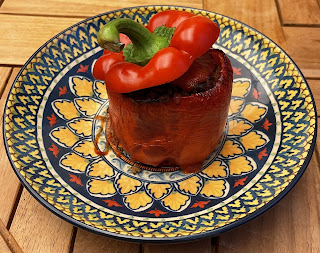
There were lots of food references in A Spare Life. Beans were eaten regularly, and for a while, I thought I’d be making a bean dish for this blog post. But then I read a passage about the foods that Zlata and Srebra’s mother cooked throughout the week, and found that Sunday was stuffed pepper day. That sounded a lot more interesting than beans, so I looked online and found a recipe for Macedonian Stuffed Peppers on the Iron Stronghold website. The only substitution I needed to make was to replace the ground beef with Impossible meat. This turned out to be a very tasty and very pretty dish.


GIVE

The GlobalGiving website listed three projects in North Macedonia, which meant I had to figure out how North Macedonia differed from Macedonia. Apparently, there was a dispute between the Republic of Macedonia and the Macedonian region of Greece as to the use of the name. So in 2019, the Republic of Macedonia changed its name to the Republic of North Macedonia.

At any rate, of the three projects listed at GlobalGiving, the one I chose was one giving trauma-informed care to orphans. North Macedonia has been working to move children out of orphanages and into foster care or group homes. This project will assist in this effort by providing: “1) Seminars in Trauma-informed Care for foster families and group home caregivers, and 2) Daily care for special needs orphans through The JOY Home Day Center, which will give 6 children support through therapies, attachment-centered play, and trauma-informed care.”

More information about this project is available at Give Trauma-Informed Care to Orphans in Macedonia - GlobalGiving.


NEXT STOP: MADAGASCAR


Saturday, February 5, 2022

LUXEMBOURG


READ


I was afraid I might have trouble finding a book from Luxembourg that had been translated into English. Ann Morgan, the woman who inspired this project, had a terrible time finding something to read from Luxembourg, and ended up reading an unpublished manuscript that had been sent to her by the author.

Fortunately, my Internet search turned up a link to Black Fountain Press, a Luxembourg publishing house that was established in 2017 for the express purpose of publishing works by Luxembourgish authors who are writing in English. There weren’t any novels on their website, but there was a book of short stories – On the Edge written by Black Fountain Press co-founder Anne-Marie Reuter. When I first contacted Anne-Marie about purchasing a copy of her book, the Covid-19 pandemic was raging in Europe and it was impossible to get the book shipped to me. When things opened up a bit, Anne-Marie was kind enough to send me a copy of On the Edge as a gift.

On the Edge is a collection of stories about people who have been pushed by life’s circumstances to a place far outside their comfort zones. Among my favorites:

·       “Stalking” introduces a man sitting in his car in a school parking lot. He’s unhappy about his divorce and his role as weekend parent, so he drives to the school every afternoon just to catch a glimpse of his children as they leave the building when classes are over.

·       “Ray for Raymond” is a cautionary tale about an accountant who is very concerned with appearances. But then he has to tell his wife and daughter that they have all been living beyond their means.

·       “Miss Gina” is a poignant story of an elderly housekeeper who has worked for the same family for years and whose happiest hours are those she spends at work.

·       One faux pas at a dance class in “Pas de Deux” causes a family to unravel.

The stories in On the Edge offer brief glimpses into the lives of a variety of characters, capturing a moment, a day, or, in some cases, many days as they wrestle with whatever it is that has pushed them to the edge. I enjoyed reading short stories for a change, with so much feeling packed into just a few pages. Many thanks to Anne-Marie for sharing her beautiful writing with me.


COOK


In searching online for a Luxembourgish dish to prepare, I found the Anne’s Kitchen website, which is chock full of Luxembourgish recipes. I decided to try making her Wäinzoossiss sausage rolls without, of course, using Wäinzoossiss sausage. I substituted Beyond Sausage Brats, used a puff pastry with no animal products, and brushed the tops with Just Egg thinned with almond milk. These turned out to be some pretty tasty little morsels, and so easy to make. 


GIVE


Since Anne-Marie had given me her book at no cost, I asked if she would like to recommend an organization in Luxembourg to receive my donation. She chose Stëmm vun der Strooss, which works with homeless people, the unemployed, low-income people, former prisoners, asylum seekers, immigrants, and people with mental disorders or drug/alcohol dependencies. They provide a variety of goods and services, including food, clothing, counseling, and medical care. More information about Stëmm vun der Strooss is available on their website or their Facebook page.


NEXT STOP: MACEDONIA