Tuesday, September 20, 2022

MONACO


READ


Trying to find a book to read for Monaco was no easy feat. The best that Ann Morgan, who was my inspiration for this blog, was able to come up with was a biography of Princess Grace. So I was thrilled when I found out that an author born in Monaco had written a thriller in English.

My excitement didn’t even last through the first chapter. The Datura Solution, by Patrick Faure, was pretty terrible. The protagonist is a man named Max Foreman, who is part of some sort of black ops mission for the United States, even though he is from Monaco. The first part of the book, which has virtually no connection to the second part of the book, follows his exploits during a mission that goes bad in Algeria, forcing Max to sneak into Morocco and then later flee to Spain. As nearly as I can tell, the only purpose for the first 155 pages is to place Max at the location where he will meet Elena McMillan, the wife of the U.S. Ambassador to Spain.

Elena is a beautiful young Russian woman, a former model, who was previously married to the extremely rich oligarch, Oleksandr Krasnaief. When he dies suddenly, she marries her lover, a U.S. diplomat named George McMillan. McMillan is a thoroughly despicable man, a womanizer whose reason for wanting to marry Elena is to get his hands on the billions of dollars left to her by her late husband. With the help of Elena’s money and connections, he becomes the Ambassador to Spain.

His own loathsomeness and Elena’s growing fondness for Max, who rescues her from a life-threatening situation, help to prevent George from getting his hands on Elena’s fortune. A battle ensues.

This book was riddled with errors – proofing, grammatical, and translation – which made reading it a challenge. Add to that various plot inconsistencies, lurid and disgusting sex and torture scenes, and confusing action sequences and you end up with a book that is not worth the purchase price. I was horrified to see it described online as “Book 1 in the Max Foreman Series,” which means the author is working on a second book.

I learned nothing about Monaco from The Datura Solution, and I wouldn’t recommend it to anyone. For others who are doing a reading-the-world challenge, I hope a better book by a Monégasque author is available by the time you’re ready to read a book from Monaco.


COOK


In searching the Internet for a Monégasque dish to prepare, I discovered a popular street food snack called socca. Made with chickpea flour, socca is a type of savory crepe. The recipe I found on the Global Table Adventure website could not have been any easier. Like the creator of the recipe, I didn’t have any chickpea flour, but I did have garbanzo fava flour. Unfortunately, I wasn’t a fan of the socca. If I found a vendor selling it on the streets of Monte Carlo, I’d definitely buy some, though, if only to find out what it’s really supposed to taste like.


GIVE


My donation to the country of Monaco went to the Institut Océanographique, which seeks to educate people about the importance of the oceans and the need to protect them. It was founded in 1906 by Prince Albert I, and continues to be supported by the current Prince Albert and the government of Monaco. The Institut Océanographique includes a museum with an aquarium and other natural history exhibits. More information about the Institut Océanographique is available at: L'Institut Océanographique de Monaco, Fondation Albert 1er. (oceano.org).


NEXT STOP: MONGOLIA


Monday, September 5, 2022

MOLDOVA


READ


The title of the book I chose for Moldova pretty well sums up the theme of the plot: The Good Life Elsewhere, written by Vladimir Lorchenkov and translated by Ross Ufberg. The book is both funny and tragic, peopled with characters who want to live almost anywhere except where they actually reside, the village of Larga in Moldova.

Their ultimate wish is to move to Italy, thanks in large part to a villager named Serafim, who has been reading about Italy and learning Italian for twenty years. The people of Larga believe that a person can earn a thousand euros a month working as a housekeeper, compared to the pittance they’re able to earn in Larga.

In the book’s opening chapter, a few dozen villagers who paid four thousand euros each to human smugglers think that they have finally reached the land of their dreams. “They’d left behind the poverty, the Moldovan devastation, the repellent earth that, no matter which way you worked it, when you planted corn you reaped just the husks.” The villagers’ elation is short-lived, however, when they discover they have not been delivered to Rome as they’d been promised.

The problem is that Italy doesn’t want them. Visa applications from citizens of Moldova are routinely denied by the Italian government. One Italian diplomat tells another as they work their way through a pile of visa applications, “Not a single Moldovan citizen gets a visa these days allowing him to stay in our country, let alone tourist or work visas. Still, we’ve got two hundred thousand Moldovans.” They won’t even grant visas to Moldovan Members of Parliament or the Moldovan President because they’re convinced that, once they get a toe-hold in Italy, they won’t leave.

Regardless of whether they’re wanted in Italy or not, the villagers of Larga continue dreaming up ways to go there, and subsequent plots become increasingly brazen and bizarre. Soon, it’s not only people from Larga but citizens throughout Moldova who are trying to flee their country for the good life in Italy. One man tries to warn people that their vision of Italy is an illusion, and that pining after it is keeping them from improving their lot in Moldova. That speech doesn’t end well for him.

The absurd plots that are hatched by the villagers are what gives the book its humor. A tractor that’s turned into an airplane, then later into a submarine, in order to infiltrate Italy by air or by sea; a crusade by tens of thousands of Moldovans trying to claim Italy for Eastern Orthodox Christians; and the effort by several people to learn the sport of curling so they can travel to Italy for a curling competition are just a few of the plans that are attempted.

After reading The Good Life Elsewhere, I can only hope that real life in Moldova isn’t as abysmal as the life portrayed in the book!


COOK


Food was barely mentioned in The Good Life Elsewhere, so I searched the Internet for a  Moldovan dish. I found a recipe for sarmale, stuffed cabbage rolls, on the Peace Corps website. I substituted ground vegan OmniPork for the ground pork in the recipe, and I used JUST Egg in place of the egg. This recipe was very labor-intensive and took a lot of time to make, so I wish I could say I really liked it. Alas, that would be a lie. You win some, you lose some.


GIVE


GlobalGiving’s website listed a project for Moldova that caught my attention: the construction of an environmental training center in an emerging Eco-village. The project’s description is like a real-life depiction of the problems facing the villagers of Larga in The Good Life Elsewhere.

“Lack of knowledge and industrial agriculture have degraded Moldova’s previously fertile black soils. Inefficiently built houses make it extremely hard for people to pay ever-rising energy bills. Trust and social cohesion in communities is crumpling and youth see no opportunities. This leaves people hopeless and drives migration, especially from rural areas. In 20 years about a quarter of [the] population moved abroad. Very few positive examples of building vibrant resilient communities are visible.”

The environmental training center proposed in this project “will serve as a regional hub for practical education in the fields of organic agriculture, energy efficiency, eco-construction and community development.” It is hoped that the project “will support the local community through job creation and educational opportunities.”

More information about this project is available at: Build an environmental training center in Moldova - GlobalGiving.


NEXT STOP: MONACO

Saturday, August 27, 2022

MICRONESIA


READ


I’m aware of only one book from the Federated States of Micronesia that’s been translated into English, which is why I ended up paying an exorbitant sum of money to an online bookseller for a used copy of The Book of Luelen, written or dictated by Luelen Bernart and translated and edited by John L. Fischer, Saul H. Riesenberg, and Marjorie G. Whiting.

This book recounts folk stories and other facts about the Micronesian state of Ponape, now known as Pohnpei. These stories were collected and recorded between 1934 and 1946 by Bernart, who was “concerned that Ponapeans of later times should know their own culture and the events of their past.”

While the stories circle around a bit, and are often repetitive, they essentially describe how people first came to Ponape and how their society progressed. According to legend, a man named Japkini made a very large and very deep canoe, with the help of two women – Lipalikini and Lijapikini. They and several other people went on a voyage in the canoe, looking for land. They eventually came to a coral reef, which they built upon to form a piece of land they called Ponpei.

The stories are full of cannibals, giants, demons, and spirits. In addition to these folk tales, however, there are entire chapters listing the various types of flora on the island and the uses for the flora – food, medicine, fiber, oil, and building material, to name a few. Bernart includes information about what people wore and what they ate. He discusses how the land was divided and who the rulers were; which spirits or gods were worshipped and who were their priests.

There are also chapters about the foreigners who came to Ponape, both as rulers and as visitors. Apparently, more ships came to Ponape from America than other lands. Foreigners brought tobacco, alcohol, and firearms to the island, and according to Bernart, “[t]he inhabitants of Ponape did not like foreign ways.”

H. E. Maude, a British Colonial Service administrator, historian, and anthropologist, explains in the foreword “the paramount importance of local oral tradition: as an offset to racist bias in European literature, and as our main source for reconstructing the history of the immediately pre-European contact period.”

As a layperson, I have to admit that I found The Book of Luelen to be somewhat tedious, but for anthropologists and historians, I’m sure it provides a wealth of information.


COOK


According to The Book of Luelen, plants available to the Ponapean people for food included breadfruit, Polynesian chestnuts, mangos, yams, taro, and bananas. In searching for a Micronesian recipe, I found one that called for two of these items and very little else.

The recipe for Micronesian Sweet Potatoes and Bananas on the InternationalCuisine.com website could not have been any easier. Peel, cut up, and boil a couple of sweet potatoes; peel, slice, and fry in margarine three bananas; then mix the boiled sweet potatoes in with the bananas. The recipe called this a side dish, but from my point of view, it made a perfect breakfast. 


GIVE


In the first chapter of The Book of Luelen, when trying to build the land that later became Ponape, Japkini and his fellow voyagers had to contend with the waves from the sea destroying their work. They called upon two forces to come and protect the land from the waves. One was Katenenior, the barrier reef, and the other was Katinanik, the mangrove.

Coral reefs are still vital to the people of Micronesia, and I was happy to find on the GlobalGiving website a project to help monitor and protect the health of Micronesian coral reefs. According to the project description, “50% of coral reefs have died in the last 30 years and 90% are projected to die within the next century.” In response, an organization called OneReef and local communities are working “to enforce no-take areas, monitor reef health, and build social cohesion.” The hope is that “island communities of Pohnpei will more effectively protect and monitor coral reef ecosystems and reinforce traditional stewardship.”

More information about this project is available at: Equip rangers to save coral reefs in Micronesia - GlobalGiving.


NEXT STOP: MOLDOVA


Monday, August 22, 2022

MEXICO


READ


There were so many books by Mexican authors to choose from that I had a hard time picking just one. In the end, I decided on a bestseller from years past that I had never read.

Like Water for Chocolate, written by Laura Esquivel and translated by Carol Christensen and Thomas Christensen, is the story of Tita De la Garza, as told by her great niece. Tita was the daughter of Juan De la Garza and his wife, known to all as Mama Elena. Juan died when Tita was two days old, leaving Mama Elena to raise Tita and her two older sisters, Gertrudis and Rosaura, by herself. Early in her young life, Tita discovers that she has great culinary skills, so she is consigned to the kitchen with Nacha, an old servant beloved by Tita.

Mama Elena tells Tita, that as the youngest daughter in the family, she will never be allowed to marry. Instead, it is an old family tradition that the youngest daughter must take care of her mother until the day she dies. Tita is heartbroken, then, when she meets and falls in love with Pedro Muzquiz. He comes with his father to ask for Tita’s hand, but Mama Elena is a hard woman, and the answer is no.

Mama Elena’s meanness is mentioned many times throughout the book, often by way of culinary metaphors. Her skill at carving up a watermelon is described this way: “Unquestionably, when it came to dividing, dismantling, dismembering, desolating, detaching, dispossessing, destroying, or dominating, Mama Elena was a pro.” Another passage in the book discusses her approach to killing chickens or quail, followed by a particularly poignant comparison: “Mama Elena was merciless, killing with a single blow. But then again not always. For Tita she had made an exception; she had been killing her a little at a time since she was a child, and she still hadn’t quite finished her off.”

None of this seems fair to Tita, and indeed, it is not. She questions who will take care of her when she gets old, if she’s not allowed to marry and have children. And who will take care of the married women who can’t have children? Who decided that the youngest daughter rather than the eldest was the best suited to take care of her mother? But she keeps these questions to herself because no one argues with Mama Elena.

While she may not express her emotions in words, Tita’s feelings have a way of finding their way into the food she cooks for parties and other special occasions. Many times throughout the book, the guests have a surprising reaction to Tita’s food. Sometimes it acts as an emetic, and other times as an aphrodisiac, without any willful action on Tita’s part. The plot of Like Water for Chocolate is laced with other instances of magical realism as well, things that would never actually happen but seem entirely natural in the story.

Tita’s life is so hard, through no fault of her own, and I was on her side every step of the way. Like Water for Chocolate is a cautionary tale about the folly of insisting that traditions or customs be observed for no other reason than that it’s always been that way.


COOK


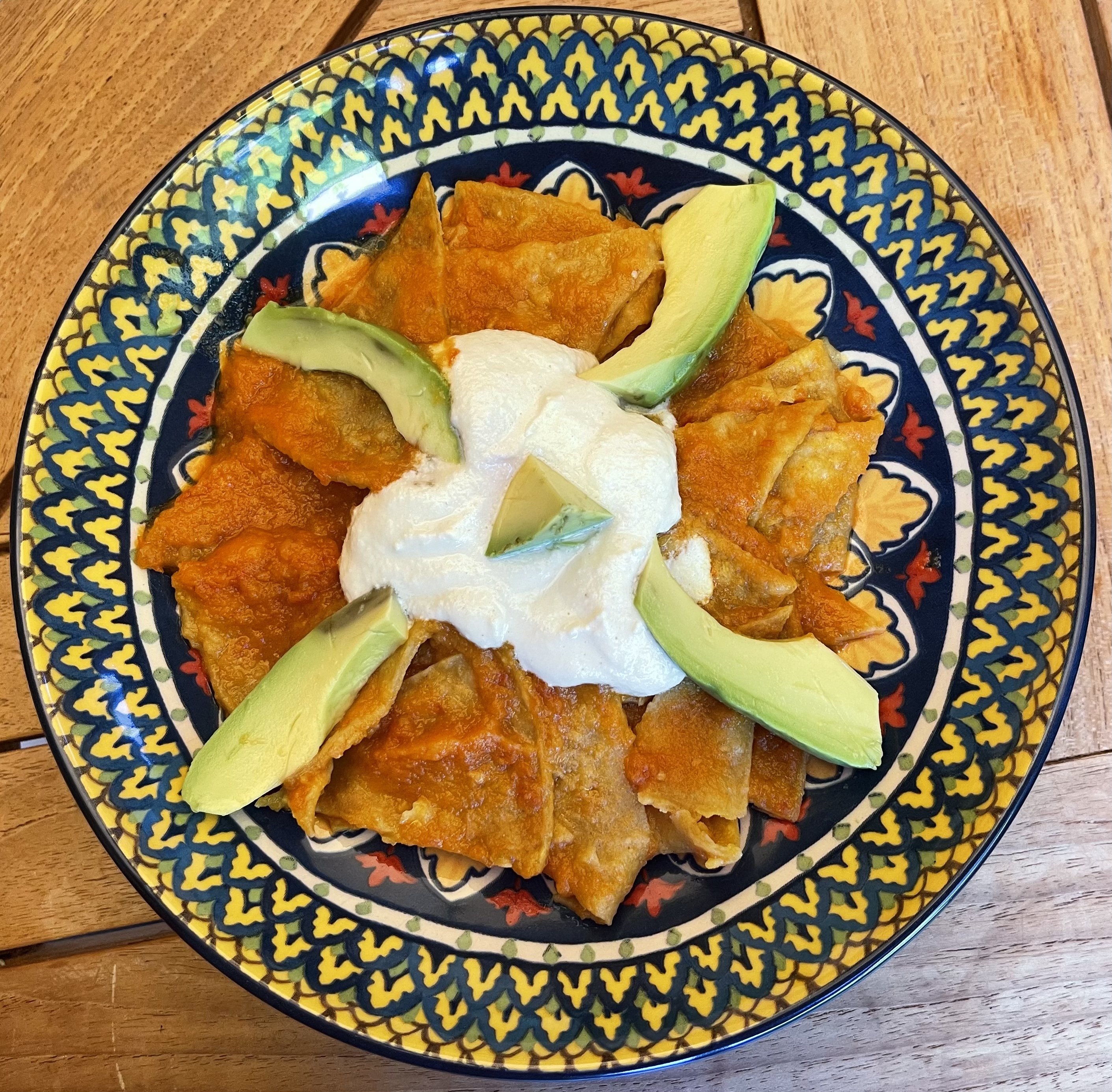
Each chapter of Like Water for Chocolate begins with a recipe for something Tita is going to prepare. Most of the recipes aren’t easily veganizable, although I considered trying to make a couple of them. In the end, I decided to make chilaquiles, a dish that seems to be a type of comfort food for Tita, reminding her of the old servant Nacha. At one point, Tita “prepared some chilaquiles and sat down at the kitchen table to eat them. She didn’t like to eat alone, but when it came right down to it, she had no choice…”.

I found an easy chilaquiles recipe at thekitchn.com. The only part of the recipe that required any tweaking was for the toppings. I couldn’t find vegan queso fresco at the store, so I made a vegan crema instead from a recipe on the Broke Bank Vegan website. This was a very enjoyable dish, and the reheated leftovers were tasty too.


GIVE


In the fight against climate change, one important component is the protection of mangrove forests. Mangroves are trees that grow in tropical coastal swamps, and according to Conservation International, they “store more carbon per unit area than any other ecosystem on Earth."

A project I found on the GlobalGiving website would train local people to become guardians of the mangroves at Bahia Magdalena on Mexico’s Baja Peninsula. According to the project description: “This project will help empower the local community through individuals who will receive capacity and training to become nature stewards. This capacity will enable them to take part in monitoring and surveillance activities of the ecosystem. Their active participation will contribute to the preservation of 1,700 hectares [approximately 4,200 acres]  of mangrove forests, their natural inhabitants, and the services they provide for the local communities and its future generations.”

More information about this project is available at: Create 50 guardians for Bahia Magdalena mangrove - GlobalGiving.


NEXT STOP: MICRONESIA

Friday, August 12, 2022

MAURITIUS


READ


If you’re like me, you probably know very little about the Republic of Mauritius, an island nation located in the Indian Ocean. During the past several centuries, it was controlled at various times by the Portuguese, the Dutch, the French, and the British before finally gaining its independence in 1968. The Last Brotherwritten by Nathacha Appanah and translated by Geoffrey Strachan, describes a period during World War II, when Mauritius was under the rule of the British.

The book’s narrator is Raj, who is about seventy years old. He is a widower with a grown son. Raj asks his son to drive him to a nearby village so he can visit the cemetery. The grave he visits bears this inscription on the headstone: “David Stein 1935 – 1945.” Raj cleans the headstone and leaves a little red box containing a Star of David on the grave.

Raj recounts his childhood in the town of Mapou, where the sugar cane factory is the dominant presence. His father, a drunken brute, works in the sugar cane fields and his beloved mother works in the home of one of the factory’s bosses. Raj has an older brother, Anil, and a younger brother, Vinod, and the three boys are very close. A sudden and devastating storm brings great tragedy to the family, resulting in a move to the town of Beau-Bassin. There, Raj’s father takes a job as a prison guard.

Raj takes lunch to his father at the prison every day, and then hides in the bushes to see what goes on there. He is shocked to see a line of white people – men, women, and children – “…very thin, dragging their feet in silence, slowly following the dirt footpath, then spreading out across the compound.” A young boy about the same age as Raj moves away from the group and begins walking in the direction where Raj is hiding. The boy sees Raj too, and that is the beginning of their friendship.

Sometime later, Raj’s father beats him so badly that he must be cared for in the prison hospital, and the friendship between Raj and the boy – David – blossoms. David is in the hospital because he has malaria. The boys manage to sneak out of the hospital at night and play on the prison grounds, conversing as best they can in French, since neither speaks the language of the other. Raj learns that David is from Prague, both of his parents are dead, and he and the other people in the prison are Jews waiting for a ship to come and take them to Eretz – Israel.

Raj knows nothing of World War II, and it isn’t until much later in his life that he learns the sad story of the Jews who had managed to escape from Europe and make their way to Palestine, only to be turned away by the British and interned at the Beau-Bassin prison.

The Last Brother is a heartbreaking story, made even more poignant by the narrator’s regrets and grief, still fresh sixty years after he first met David. I will not soon forget these characters and their touching story.


COOK


After the trouble I had finding a dish to make for my post about Mauritania, Mauritius was a huge relief. According to Wikipedia, “Mauritian cuisine is a blend of African, Chinese, European (mostly French) and Indian influences in the history of Mauritius.” I found so many vegan or veganizable Mauritian recipes that it was hard to decide which one to attempt. I finally chose the Mushroom, Corn, and Cashew Curry recipe on the Mauritian Cuisine website.

This recipe was easy to make, and, aside from the fact that it was a little on the bland side, I was happy with the way it turned out. There was one ingredient – asafetida – that I didn’t have in my spice cupboard, but I was able to find it at an Indian market not too far from my house.


GIVE


A little over two years ago, the Japanese carrier MV Wakashio ran aground on a coral reef off the coast of Mauritius and began leaking oil. Ile aux Aigrettes, a nature reserve managed by the Mauritian Wildlife Foundation, was adversely impacted by the 800 tons of oil that spilled into its lagoon.

I found a project on the GlobalGiving website that allowed me to donate to the Mauritian Wildlife Foundation to help them monitor “the populations of plants, birds, reptiles and insects” that might have been affected by this spill. According to the project description: “The project will restore the ecosystem of Ile aux Aigrettes, an island nature reserve, home to endangered endemic plants and animals. Every year the islet welcomes 4,000 school children on a Learning with Nature tour, and another 15,000 tourists and visitors, making it a well sought after, unique and true ecotour experience. Maintaining such plant and animal populations also protects these species from extinction.”

More information about this project is available at Wakashio Recovery Action Plan - GlobalGiving.


NEXT STOP: MEXICO

Sunday, August 7, 2022

MAURITANIA


READ


The Desert and the Drum, written by Mbarek Ould Beyrouk and translated by Rachael McGill, tells the sad story of Rayhana, a Bedouin teenager who lives with her mother and their tribe in a camp in the desert. Her father left the family when she was six years old, angry because of his wife’s deference in all things to her brother, the chief.

Rayhana’s life is happy enough, and she has a circle of friends with whom she spends her free time. One day, an itinerant mining crew sets up camp near Rayhana’s tribe. The Bedouins are uneasy about having them nearby, and the chief tells them not to go near the miners. According to Rayhana, “We closed our eyes to them because, deep down, we were ashamed we had allowed their presence to be imposed on us, ashamed of our failure to understand it, to confidently accept or reject it.”

This seems very much like the way Rayhana would feel later, when one of the miners, Yahya, starts spending time with Rayhana and her friends and begins a flirtation with Rayhana. She enjoys the attention, but is horrified when he sneaks into her tent at night while her mother sleeps nearby. She is afraid to say anything, since she knows that she will be blamed, and ends up quietly letting him do as he pleases. One day, the mining crew leaves without a word, and Yahya disappears from Rayhana’s life.

He has left her pregnant, a fact that enrages her mother when she finds out. Her mother ensures that no one else in their tribe finds out by sequestering Rayhana far away until after she has given birth. Rayhana bonds with her baby boy, Marvoud, but then her mother gives him to someone else to raise. She and Rayhana go back to their tribe, and when Rayhana tries to find her baby later, she discovers that her mother has taken him somewhere else. In her anger, Rayhana steals her tribe’s sacred drum and heads off into the desert alone in search of her son.

Rayhana’s travels take her first to the town of Atar, and later to the capital city, Nouakchott. In both places, life is very different from her desert existence with her tribe. For most of the book, it feels as though everything is taking place in the distant past, so it’s a shock when cars and cellphones suddenly make an appearance. Rayhana adjusts the best she can, but she also has to cope with the knowledge that members of her tribe are looking for her and the tribal drum, and that they won’t stop until they find her.

Throughout The Desert and the Drum, I hoped for a happy ending for Rayhana, as her journey took her from carefree young girl, to the plaything of an unscrupulous man, to devoted mother, and finally to a fugitive from her tribe because of the stolen drum. As she says toward the end of the book, “Their pain was nothing to mine. They’d lost a drum; an object was no longer in its proper place. I had a crater in my soul. Only reunion with my child would fill the void.”


COOK


It was tough to find a recipe for a Mauritanian dish that I could veganize. Beignets are mentioned in several places throughout The Desert and the Drum, but not the Café Du Monde powdered sugar kind that we’re used to. The Mauritanian beignets are served with a spicy sauce made with “onion, garlic, tomato puree, pepper and salt,” but I couldn’t find a recipe for them online. Apparently camel and goat are staples of the Mauritanian diet, but as far as I know, no one is making vegan versions of those meats yet (although I saw a vegan lamb burger on the menu at a local restaurant recently). Finally, I found a recipe for Coconut Pepper Steak on the “What’s Cooking in your World?” blog, and decided I could veganize that.

I took a lot of liberties with this recipe. For the skirt steak, I substituted Gardein b’ef tips, and I used vegetable bouillon instead of beef bouillon. I couldn’t conceive of any way to deconstruct a coconut that didn’t involve hurting myself, so I bought a carton of coconut water and a package of Trader Joe’s dried, lightly-sweetened coconut strips, then rinsed off the top layer of sugar. And I couldn’t find corn flour, so I used coconut flour to thicken the sauce, since coconut was already part of the recipe anyhow. When I was done, I had a tasty enough dish, albeit a little too spicy, but I’m sure it bore no resemblance to anything that’s ever been eaten in Mauritania. Oh, well… 


GIVE


Although Mauritania faces severe consequences due to climate change, I couldn’t find a way to donate to any organization addressing that problem. GlobalGiving listed only one Mauritanian project on their website, but it was a good one – helping to educate 120 girls.

According to the project description, only 42 percent of females in Mauritania are literate. “Girls are restricted to chores inside the home as ‘house servants.’ This prevents them from attending school and developing the skills they need to succeed in life and understand their rights.” This program will provide a “dance program, which develops 7 cognitive & life skills – such as memorization, discipline, creativity – needed for success in school and life. The girls will receive 3 additional services to change their lives: sponsorship in formal education, psychosocial counseling, and nutritional support, enabling the girls to develop confidence, academic readiness, & the sustained ability to make positive life decisions”

More information about this project is available at: Educate 120 Girls in Mauritania - GlobalGiving.


NEXT STOP: MAURITIUS


Friday, July 1, 2022

MARSHALL ISLANDS


READ


I couldn’t find a book written by an author who was born in the Marshall Islands, so I got the next best thing: a book of stories told by Marshallese storytellers to a non-Marshallese writer. Marshall Islands Legends and Stories was collected and adapted by Daniel A. Kelin II, and illustrated by Marshallese artist Nashton T. Nashon.

According to Kelin, “It is not customary for storytellers in the Marshall Islands to share legends with just anyone. By custom the iroji [chiefs] own the legends, and the ones who are chosen to remember them can share them only when the iroji says so.” Kelin traveled from island to island meeting the local storytellers, and he shares short profiles of each of them in the book. These pieces include information about the recent history of the Marshall Islands, especially during the World War II years, when Japan was in control of the islands.

Several themes recur often in the stories collected in this book. There are many cautionary tales about not following the rules or customs, frequently ending in the death of the rule breaker or someone close to them. For example, there’s a story about an iroji who married two demon sisters and wanted to take them back to his island. Their parents told him that if he took their daughters with him, he must keep them beside him at all times. One day, he forgot and went fishing by himself. A storm blew him away and he was never seen again.

The importance of sharing is another popular theme, along with the need to stay on the good side of the iroji by bringing him gifts. In one story, a woman is struggling to find food for herself and her son. A man appears to her in a dream and tells her what she needs to do to find enough food every day. She does as he suggests, and suddenly has more than enough food. She tells her son that they must follow the custom of ejtōbtōb. “If you eat good food and don’t share with the others of the island, then you’ll always stay hungry. But first, we give some to the iroji. 

Demons play a key role in many of the stories. One legend that I found interesting was the belief that if “a man went away before his pregnant wife gave birth, she’d become a mejenkwaad [demon wife] ready to devour her husband when he returned.” There are also several stories about Letao, the trickster, many of which include this ending: “Letao is now in America. That’s why the people there are so smart.”

The book is illustrated throughout by Nashton T. Nashon, who “consulted elders and researched traditional Marshallese history and culture to create the drawings and tattoo design.”

I enjoyed learning a little about the Marshall Islands through these stories and drawings, especially since I’d known nothing about the islands previously. 


COOK


The Marshallese dish I prepared for this blog post was so good that my husband Phil and I ate the whole thing before I even finished reading the book. It was Marshall Islands Macadamia Nut Pie, from a recipe I found on the allrecipes website. I took a couple of shortcuts – buying a frozen pie crust shell instead of making my own, and using So Delicious CocoWhip instead of trying to create a vegan coconut-flavored whipped cream substitute myself. The only thing I did to veganize the recipe was to replace the eggs with JUST Egg. The pie was delicious – very similar to pecan pie. 


GIVE


The Marshall Islands are expected to be severely impacted by climate change. According to an article on The Conversation website: “By 2035, the U.S. Geological Survey projects that some of the Marshall Islands will be submerged. Others will no longer have drinking water because their aquifers will be contaminated with saltwater. As a result, Marshallese would be forced to migrate away from their homelands.”

There was only one project for the Marshall Islands on the GlobalGiving website, but I was happy to see that it related to climate change. According to the project description: “The project will help disseminate information about the climate crisis to disadvantaged communities, which often do not have a strong infrastructure for climate change education, promote dialogue between climate activists and indigenous frontline communities, and empower youth, especially from indigenous communities and other marginalized communities, to take action.”

More information about this project is available at: Activating Frontline Communities - GlobalGiving.


NEXT STOP: MAURITANIA