Saturday, April 18, 2020

GUINEA-BISSAU


READ


I knew when I picked up a book called The Ultimate Tragedy that I was not going to be writing a very uplifting blog post about the West African country of Guinea-Bissau. This book, by Abdulai Sila, tells the story of Ndani, a young Bissau-Guinean woman who leaves her village to look for work in the city. She wants to leave the village not only for better opportunities, but because the local djambakus, a religious leader, has declared that Ndani has a wicked spirit in her and that she will live a life full of tragedy. Since that time, no one in the village has wanted anything to do with her except for her stepmother, who is her friend and confidant.

Ndani finds work in the home of a Portuguese couple. The wife isn’t happy to have her there at first, but that changes when she decides that it’s her duty to convert Ndani to Christianity. The husband’s intentions are considerably less spiritual, and Ndani ends up having to leave the household.

She goes back to her stepmother’s house and stays there until the Régulo (village chief) decides that, since Ndani is educated and has lived in a white household, he wants her to be his wife and take care of the big house he’s having built to upstage the Portuguese Chief of Post who has insulted him. That doesn’t work out the way the Régulo had intended it to, and he moves out, leaving Ndani in the big house. Soon, the local schoolteacher fills that void, and he and Ndani have a son together.

Circumstances permit Ndani and the teacher to build a life together, and they move to a different town with the hope of starting over. However, tragedy follows Ndani once again.

The Ultimate Tragedy is a classic tale of man (or, in this case, woman) against fate. Ndani has done nothing to warrant her tragic destiny, and no matter how she tries to outrun it, things never end up going well for her. The teacher, who was educated by Catholic priests, believes the prophecy by the djambakus is just a superstitious belief and that evil spirits don’t exist, but he suffers because of his relationship with Ndani too. The ultimate tragedy appears to be that Ndani cannot escape her destiny, and neither can the people closest to her.


COOK


I found a vegan recipe from Guinea-Bissau on the allrecipes.com website. It was posted by a woman who had been a Peace Corps worker there. The dish is Guinean peanut sauce with butternut squash, and it was very easy to make. Stewed chunks of butternut squash are simmered in a sauce made of peanut butter and tomato. It sounds like an odd combination, but it was actually quite good.


GIVE


There was only one project for Guinea-Bissau listed on the GlobalGiving website, so that’s the one I chose. Fortunately, it sounds like a great project helping rural communities in one of the poorest areas of the country. According to the website: “The project will install clean water wells, build latrines, establish market gardens and train young people and women on how to maintain these resources and take ownership of their community's development” in five remote villages. This is immensely important in a region where people have to walk for hours every day just to find water. More information about this project is available at https://www.globalgiving.org/projects/water-health-and-womens-empowerment-guinea-bissau/.


NEXT STOP: GUYANA

Wednesday, February 5, 2020

GUINEA


READ


The book I read for Guinea, Camara Laye's The Radiance of the King, tells the story of Clarence, a Frenchman who has traveled to an unnamed African country for reasons that are never explained. He has gambled away all his money, been kicked out of the luxurious hotel catering to white people where he had been staying, and is being threatened with eviction by the landlord of the cheap caravanserai catering mostly to black people where he finds himself now.

He learns that the country’s king will arrive in the city soon, and he joins the throngs of people awaiting the king’s arrival. His plan is to somehow meet the king and offer his services, thinking that just by virtue of being white, he will surely be offered a post by the African king. He meets up with a beggar who says he will try to help him, but later comes back saying the king has no posts available. Clarence then travels with the beggar and a couple of mischievous boys to the southern part of the country where the king is expected to make an appearance eventually.

They arrive in a village where, unbeknownst to Clarence, the beggar trades Clarence to the head of the village to serve as a stud to his harem. A powerful narcotic keeps him from realizing what is happening to him, and when he finally discovers the truth, he tries unsuccessfully to escape. He becomes more determined than ever to meet the king, but as the day of the king’s arrival grows closer, Clarence’s shame at the person he has turned into nearly prevents him from finally presenting himself to the king.

The story seemed almost like a biblical parable to me, with Clarence representing a sinner and the king representing his salvation. However, in the great Toni Morrison’s 2001 review of The Radiance of the King, she writes that she doesn’t think Clarence’s trials “imitate an Everyman’s pilgrimage through sin and self-loathing necessary in order to effect an ultimate baptism.” Rather, she sees Clarence’s journey as one of personal growth, from a state of “immaturity and degradation” to one of truth and self-awareness. Morrison’s review can be found at https://www.nybooks.com/articles/2001/08/09/on-the-radiance-of-the-king/.


COOK


No particular Guinean dishes were mentioned in The Radiance of the King, so I looked online to see what I could find. The International Vegetarian Union’s website had a recipe for vegetarian kansiyé, which is a lentil stew with peanut butter as one of the ingredients. I have to say I enjoyed it quite a bit more than most of the lentil dishes I’ve made in the past. Served over a bed of rice, it made a great lunch.


GIVE


GlobalGiving.com listed four projects for Guinea, and I couldn’t resist the one to protect chimpanzees, organized by the David Shepherd Wildlife Foundation. According to the project summary, “Every four hours, one chimp is being illegally taken from the wild to be traded as a pet or eaten as bushmeat. DSWF works with ground-based project partners who provide vital rescue, rehabilitation and release programmes for illegally trafficked chimps.” They also try to educate local communities about the consequences of the illegal wildlife trade in order to try to reduce the demand for trafficked chimps. More information about this project is available at https://www.globalgiving.org/projects/protecting-chimpanzees/.


NEXT STOP: GUINEA-BISSAU


Monday, January 6, 2020

GUATEMALA


READ


It’s been a long time since my last post, and frankly, there were times when I thought I’d never finish the book I had chosen for Guatemala, The President, by Miguel Angel Asturias. There were unrelated reasons for the delay – we had visits from out-of-town family and we sold our house and moved from one city to another – but it was the relentless misery facing the characters in this novel that made it difficult for me to pick it up and read it through to the end.


But it’s a new year, so I thought I’d try to get on track again. I just read the last page of The President, and am overwhelmed by the sheer horror of what life is like for people living in a country run by an unfeeling, narcissistic dictator. The setting for this novel is an unnamed Latin American country sometime early in the 20th century. It is believed that the president in this novel is based on Manuel Estrada Cabrera, who ruled Guatemala from 1898 until 1920, when he was finally forced out of office and imprisoned for corruption.


There is no such happy ending in this book, which opens with the random murder of one of the president’s most loyal military men. The president decides to use the murder to his advantage by pinning the crime on two people he believes are plotting against him. Many people are tortured into giving evidence to fit the president’s narrative, and the lives of the two men the president has accused suddenly become fraught with peril. One flees the city and goes into hiding; the other is arrested, faces a sham trial, and is executed. Camila, the beautiful daughter of the man who has gone into hiding, is abducted by the president’s closest adviser, a man known to the people as Angel Face. Throughout the book, it is said of Angel Face, “He was as beautiful and wicked as Satan.”


I found this description curious, because as the book progresses, Angel Face appears to be one of the very few characters who experiences any growth. He falls in love with the woman he has abducted, and she with him, but even before that, there are examples of Angel Face following his conscience. Perhaps his close relationship with the president makes him feel secure enough to do the occasional act of kindness for people in distress.


Unfortunately for Angel Face, in a country ruled by a brutal dictator, no one stays in favor for very long. I kept hoping for a good outcome, but in a regime where a person can be tortured or killed on a whim, and rumor and innuendo take the place of common sense and hard evidence, no one is safe. The book ends as tragically as it began.


COOK


In such a grim book, food descriptions take a back seat to the suffering of the characters. However, there were a couple of mentions of stew, so I found a recipe on ArtzyFoodie.com for Guatemalan stew that I was able to veganize.


This stew is generally made with chicken, simmered in a tomatillo sauce. Instead of chicken, I defrosted Gardein chick’n strips, sliced them into some approximation of shredded chicken, and added them to the stew for the last ten minutes of cooking. Served over white rice, this was a delicious and satisfying dish.


GIVE


GlobalGiving.com lists several projects in Guatemala, where the need is very great. It was difficult to choose just one, but I ended up donating to the type of project that always appeals to me, providing books for children in rural areas. According to the project description, “Guatemala has the second lowest literacy rate in Latin America and only one out of ten rural Guatemalans graduates from middle school.” Funds collected for this project will be used to “build lending libraries in indigenous, coffee-growing communities in Guatemala to provide children with access to books and literacy activities. We train local teachers to use library resources to weave reading and writing into the fabric of their classrooms.” By increasing the literacy rate, it is hoped that opportunities for economic mobility will also increase.


NEXT STOP: GUINEA

Monday, June 10, 2019

GRENADA


READ


If you’re old enough to remember Ronald Reagan’s presidency, you’re likely to recall when the United States invaded the Caribbean island country of Grenada. The war lasted only a few days before the U.S. declared victory, and I don’t think I’ve seen anything in the news about Grenada since.


With that as my only frame of reference, I was looking forward to learning more about Grenada for this blog post. I was very happy to find a Grenadian author who had written a thriller, which is my favorite literary genre. The Bone Readers, by Jacob Ross, is set on the fictional island of Camaho, which appears to be very much like Grenada. In fact, the book’s narrator talks about how the two hundred square miles of island territory had been enough “to frighten the hell out of Ronald Reagan in my mother’s time; enough to have him put an aircraft carrier on our horizon and launch Blackhawk helicopter gunships and F-16 bombers to pound us into the sea.”


But The Bone Readers isn’t about Grenada’s war with the United States. It’s about a young boy, the illegitimate son of the police commissioner and his servant, who grows up to become a police detective himself. Michael “Digger” Digson, a recent high school graduate with no prospects, witnesses a murder, and his powers of observation help the police identify almost all the killers. He is offered a job by the detective superintendent, which he accepts in spite of his negative view of the police.


One reason Digger agrees to go to work as a police detective is to try to uncover the truth of his mother’s death. She left the house when Digger was eight years old to attend a rally protesting the rape and murder of a schoolgirl by the son of a high-ranking official. During the protest, an order was given for the police to shoot into the crowd, and Digger’s mother was killed. However, her body was never recovered.


While Digger’s mother’s case is always on his mind, the plot centers around a cold case of a young man who disappeared a few years previously. Investigating the case leads Digger and Miss K. Stanislaus, who has been brought in to help, into dangers they couldn’t have predicted.


The Bone Readers kept me interested and entertained. If I have one complaint, it’s that the author’s use of the local patois made the dialogue a little hard to interpret from time to time. Aside from that, I really enjoyed this book. A press release from the publisher says that The Bone Reader is the first book in the author’s Camaho Quartet. The other three don’t appear to have been written yet, but when they come out, I’ll be eager to read them.


COOK


I’m afraid Grenada got short-changed in the cooking portion of this post. I had wanted to make potato pone, a type of sweet potato pudding that was mentioned a couple of times in The Bone Readers, but the recipe called for an ingredient I couldn’t find. I have family coming for a visit this week, and I really wanted to get this blog done before they arrive, since I won’t be doing any blogging while they’re here. So I just started looking for the easiest Grenadian recipe I could find.


What I found was a recipe on the Simple Grenadian Cooking website for fried plantains with only two ingredients – oil and plantains. These tasty little morsels couldn’t have been any easier to make, and they were a delicious little snack.


GIVE


There are no projects listed for Grenada at GlobalGiving.org, so I searched the Internet and found PLAN!T Now, which “encourages people and communities to access the tools they need before severe weather strikes to reduce the loss of life and destruction caused by storms.”


This organization was originally formed as the Grenada Relief Fund after the island was devastated in 2004 by Hurricane Ivan. By focusing on preparedness, PLAN!T NOW hopes to mitigate the effects of future storms. More information about this organization is available at http://www.planitnow.org/.


NEXT STOP: GUATEMALA

Friday, May 31, 2019

GREECE


READ


I looked at a few book options for my blog post about Greece. Contemporary novels such as The Scapegoat, by Sophia Nikolaidou, and The Third Wedding, by Costas Taktsis, looked interesting, but in the end, I decided to go with the Nikos Kazantzakis classic, Zorba the Greek. I wish I’d chosen a different book.


The title character, 65-year-old Alexis Zorba, is portrayed as a larger-than-life man of the earth, the perfect Dionysian foil to the narrator’s Apollonian personality. The narrator, who is never named, and Zorba meet in a café and decide to go to Crete together, where Zorba will supervise the workers in a lignite mining operation the narrator is financing.


They quickly settle into life in the village, where Zorba immediately takes up with their landlady, an older woman whose glory days are behind her. He has a pattern of seeking out widows in whichever towns he visits, assuming they’ll be grateful for his attention.


The narrator, on the other hand, is more interested in his studies. He is a student of Buddha and spends his time reading and writing. Zorba is determined to make the narrator more like him, enjoying the here and now, rather than burying his head in his books. The narrator seems to agree. At one point during a hike through the countryside, he sees a flock of cranes and thinks, “Once more there sounded within me, together with the cranes’ cry, the terrible warning that there is only one life for all men, that there is no other, and that all that can be enjoyed must be enjoyed here. In eternity no other chance will be given to us.”


It seemed to me that it would have been better if Zorba had tried to be a little more like the narrator instead, or if they had each tried to learn from the other. The choice shouldn’t have to be between purely flesh or purely spirit – a happy life should embrace both.


I know that it’s unrealistic to read older books through the lens of today’s social mores, but I was never able to get past the attitudes toward women displayed in this book. Zorba’s belief that women were just waiting to be grabbed and made love to, the disgust of one old man with the fact that his old wife was no longer young and pretty, and the agreement among the townspeople that a young widow should die because she resisted the advances of a young man who later killed himself all made me question why on earth this was such a popular book. I haven’t seen the movie version of Zorba the Greek, but I can only hope that Anthony Quinn evoked Zorba’s earthiness and joie de vivre without also glorifying his misogyny.


COOK


As one might expect in a book extolling earthly pleasures, food descriptions are sprinkled liberally throughout Zorba the Greek. The island of Crete had an abundance of fresh fruits, vegetables, and herbs, but no specific dishes were mentioned. In looking through Greek recipes online, I found one on the Gourmandelle website for a vegan pastitsio, a baked pasta dish topped with bechamel sauce, that sounded good. The list of ingredients was long, and the recipe involved lots of chopping and several different steps. The lentils and veggies could have used a little more simmering, and the bechamel sauce never did thicken. Nevertheless, the pastitsio was good – even my non-vegan husband liked it – but making it definitely requires a time commitment. 


GIVE


GlobalGiving.org listed a couple of dozen projects for Greece. Most of them involved assistance to refugees, but I wanted a project helping the Greek people themselves. I found one that provides emergency relief packages to families who are suffering the effects of the austerity measures the Greek government has been forced to adopt.  According to the project description, “63 percent of the Greek work force is unemployed or poor,” with “more than 1,000,000 jobless in Greece.”


The emergency relief packages, which are being provided to 4,750 newly-jobless parents with young children, include things like food, personal hygiene items, and school supplies. In addition, people identified for assistance receive “free psychological support sessions to both fragile parents & children, free health care and optometrist, free hairdressing, free private lessons for kids who need it.” More information about this project is available at https://www.globalgiving.org/projects/relief-distributions-greece/.


NEXT STOP: GRENADA


Saturday, May 18, 2019

GHANA


READ


After struggling with the book I chose for my post about Germany, I was happy to find a book for Ghana that kept me interested and entertained. I hesitate to call The Seasons of Beento Blackbird, by Akosua Busia, a beach read, since that conjures up an image of literary fluff, which this book was not. But it was full of romance, sympathetic characters, and beautiful descriptions of exotic locations, making it the perfect book to take on vacation.


Solomon Eustace Wilberforce is a Pulitzer Prize-winning author, who writes bestselling children’s books under the pseudonym Beento Blackbird. He is tall, handsome, wealthy, charming, kind, well-spoken – in short, he is the epitome of the saying, “Men want to be him, and women want to be with him.” He has a complicated life, although apparently it works well for him. He spends winters with his Caribbean wife Miriam on the island of Cape Corcos, summers with his second wife Ashia in a small village in Ghana, and spring and fall in Manhattan writing his books and dealing with his publisher, where his agent Sam is secretly in love with him.


Why, then, is he living as a hermit in a cave on the tiny Caribbean island of Saint Germaine when the book opens? He has been missing and presumed dead for five months, leaving behind a trail of broken-hearted women.


In spite of outward appearances, Solomon’s life is not as perfect as it seems. He has abandonment issues, stemming from no relationship with his father in the early years of his life, followed by an uneasy relationship with him in Solomon’s teen years, and rejection by his father’s wife and other children. His biggest sorrow, though, is that he has no children of his own, despite having two wives. Hiding from the world for five months gives him the time and space to work though these issues and decide what is really important to him.


The book’s author, Akosua Busia, is an actress who played the role of Nettie Harris in The Color Purple. The Seasons of Beento Blackbird is the only book she has written, which is a shame, because I would certainly like to read more of her beautiful writing.


COOK


Peanuts are an important crop in Ghana. During one of his visits to the small village where his Ghanaian wife lives, Solomon, Ashia, and her little brother and sister visit a peanut farm and eat their fill. “Solomon felt like Kummaa looked, and Kummaa looked stuffed.” With that in mind, I searched for a recipe that included peanuts and found one on Mealz.com for Ghanaian vegan peanut soup. Mealz.com is a website that advertises various food brands, which meant that the peanut rub the recipe called for wasn’t something I could find at any local grocery stores, so I left it out. I also skipped the fufu. I thought this soup was exceptionally good – the type of thing I’d be thrilled with if I’d ordered it in a restaurant, and the perfect dish for an unexpectedly rainy day.


GIVE


In The Seasons of Beento Blackbird, Solomon is passionate about making life better for children. In one part of the book, he reminds himself about why he writes the Beento Blackbird books: “Beento Blackbird, freedom flier from the Ashanti gold mines of Ghana, West Africa. My mission is to protect, enlighten, and inspire all the underprivileged and misinformed children of the world.” Solomon has traveled all over Africa doing research for his books, but the place that has been seared into his soul is Gorée Island off the coast of Senegal, which, according to the UNESCO website, “was the largest slave-trading centre on the African coast” from the fifteenth to the nineteenth century. In particular, he agonized about the room where the children had been kept. “Once alone inside the room, Solomon had slid down, leaned against the stone wall, and grieved over all the children who had died in that very spot.”


We like to think that slavery is a thing of the past, but in looking through the projects in Ghana listed on the GlobalGiving.com website, I found one titled, “Saving Children Sold Into Slavery in Ghana,” and this is the project that received my donation. According to the description on the website: “Lake Volta is one of the world's largest man-made lakes and sustains a large fishing industry. Due to extreme poverty and lack of information, some parents/caretakers give their children to fishermen, unaware of the harsh living and working conditions awaiting them. The children work extremely long hours, are mostly deprived of education and often malnourished. Some of them are exposed to physical and sexual abuse.”


The International Organization for Migration works to rescue these children, and also to educate communities about “the rights of children and the responsibility of parents and communities to protect them and not give them away to fishermen.” More information about this project is available at https://www.globalgiving.org/projects/africa-child-trafficking/.


NEXT STOP: GREECE


Thursday, May 9, 2019

GERMANY


READ


Germany has a rich literary history, so I had lots of books to choose from for this post. I decided to go with a book that’s on the late rock icon David Bowie’s list of one hundred books. The author of A Book of Book Lists, Alex Johnson, describes Bowie’s list this way: “It is a list of books he felt were important rather than his actual 100 favourite reads.”


I wish I could have seen whatever it was that Bowie saw in this book, but unfortunately, I found The Quest for Christa T., by Christa Wolf, to be confusing, hard to follow, and frankly, somewhat tedious. It tells the story of a young woman – always Christa T., never just Christa – who grows up in Germany during the Nazi era and then the Soviet occupation of East Germany.


The book’s narrator is a friend who met Christa T. during what appears to have been their high school years. They lose touch, but reconnect later in graduate school. We learn early on that Christa T. dies at a relatively young age from leukemia, and her friend, the narrator, whose name we never know, ends up with all of Christa T.’s writings. It seems that Christa T. had a fear of vanishing without a trace, so she was always writing things down – in her diary, on scraps of papers, in letters – writings that she often then destroyed “so that the right hand needn’t know what the left hand is doing.”


Christa T. goes through the motions of living – school, work, getting married, having children – but seems to find little joy in any of it. At one point, she even contemplates suicide: “Why should I go on deluding myself: there’s no gap for me to live in.” And yet something about her is a source of endless fascination to the narrator.


Apparently, this book was extremely controversial when it first came out. According to the blurb on the back of the book, “When The Quest for Christa T. was first published in East Germany, there was an immediate storm: bookshops in East Berlin were given instructions to sell it only to well-known customers professionally involved in literary matters; at an annual meeting of the East German Writers Conference, Mrs. Wolf’s new book was condemned. Yet the novel has nothing explicitly to do with politics.”


Maybe The Quest for Christa T. would be more meaningful to me if I had a better understanding of the events that were occurring in East Germany during the time covered by this novel. As it is, I’m sure the significance of many of the book’s details were lost on me, so I’m hard-pressed to explain how the government of East Germany could have found this book to be so threatening.


COOK


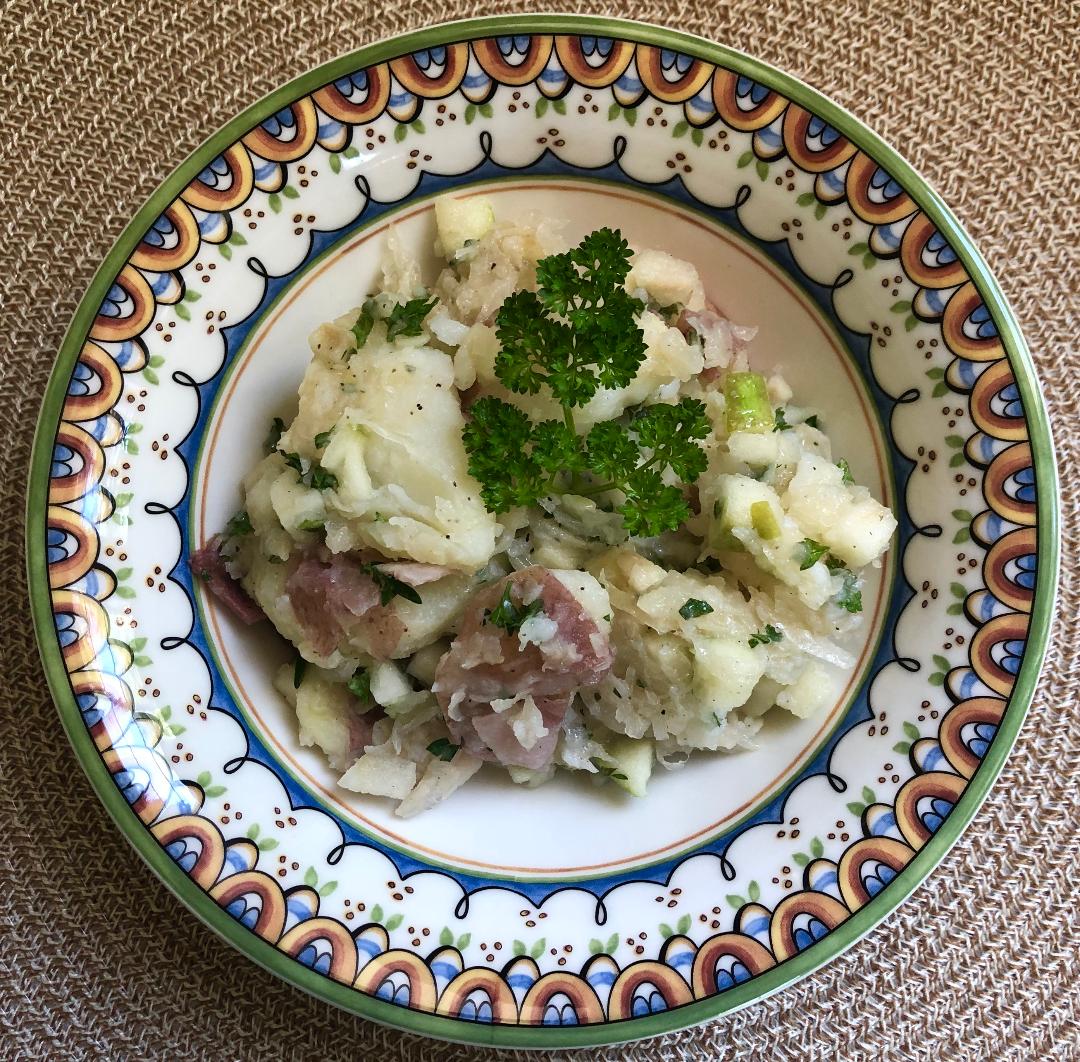
Food didn’t play a huge role in The Quest for Christa T., but there were several references to potatoes, so I made Black Forest Potato Salad from a recipe I found on the International Vegetarian Union (IVU) website. This isn’t your typical potato salad, as the ingredients include sauerkraut and an apple, both of which were also mentioned in The Quest for Christa T. The recipe was very easy to make, and it was tasty enough, but the cider vinegar and the sauerkraut made it rather more tart than I would have liked.


GIVE


One of the themes in The Quest for Christa T. appears to be the struggles that young people face in school and in life. Teachers and mentors can help students cope with these problems, which is why I chose an organization from GlobalGiving.com’s website that helps to find and support mentors for pupils in Berlin. Most of the children helped by this program live in an area in which the majority of the inhabitants are immigrants from many different countries. Among the benefits of providing mentors to the children in this program are improved language skills and increased self-esteem, which lead to better opportunities for them in the long-run. More information about this mentoring project is available at https://www.globalgiving.org/projects/pasch-mentoring-project/.


NEXT STOP: GHANA